
Microsoft Dynamics 365 recognised as a Leader across three Gartner Magic Quadrant reports
A moment that signals a shift in the ERP market
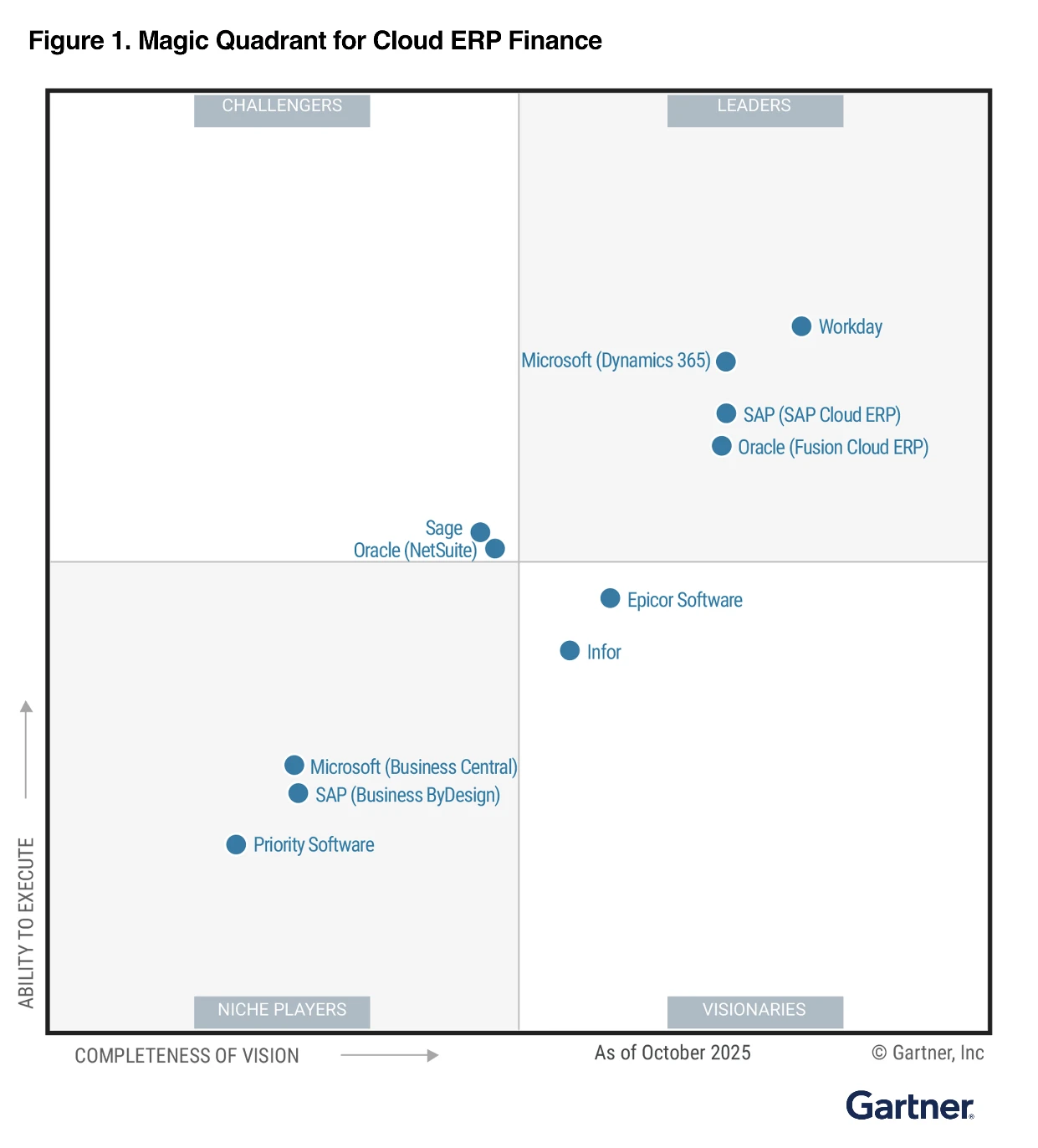
Seeing Microsoft Dynamics 365 receive a Leader position in three separate Gartner Magic Quadrant reports has captured the attention of digital transformation leaders. The recognition covers Cloud ERP for Service Centric Enterprises, Cloud ERP for Product Centric Enterprises, and Cloud ERP Finance. It places Dynamics 365 in a rare category of platforms validated across entirely different operational models.
Gartner sources: Service Centric, Product Centric, Finance
Microsoft article: source
For organisations evaluating ERP modernisation, this result carries weight. Leaders rarely want a system that limits their growth or forces compromises during operating model shifts. Dynamics 365’s triple recognition shows it can support established teams, evolving business models, and organisations investing in modern data and AI capabilities.
This moment also reflects broader momentum toward platforms that bring processes, analytics, and operational insights together through shared data and composable design.
What Gartner evaluated and why it matters for transformation leaders
Gartner’s Magic Quadrant evaluates vendors on two dimensions: completeness of vision and ability to execute. These criteria help organisations benchmark how well a platform can support real world complexity.
What Gartner highlighted about Microsoft
Across the three reports, several strengths appear consistently.
- Gartner noted Microsoft’s “broad functional capabilities across service centric and project driven organisations” in the Service Centric report.
- In the Product Centric report, Gartner described “strong integration across the Microsoft ecosystem, especially in supply chain and production planning workflows”.
- The Finance report highlighted Microsoft’s “innovative roadmap, particularly in automation and AI enabled finance operations”.
These statements are taken directly from the respective Gartner reprint documents.
Why this matters for ERP decision making
Transformation leaders gain confidence when a platform demonstrates depth across industries. At ARP Ideas, this often influences early stage architecture decisions. Leaders want clarity on four questions:
- Will the platform scale as the organisation matures?
- Is the vendor investing in capabilities that align with future needs?
- Can the system support both structured processes and adaptive workflows?
- Will the ecosystem reduce integration friction?
Gartner’s evaluation, combined with Microsoft’s roadmaps, offers reassurance on each of these points.
Why Dynamics 365 is gaining traction in modern transformation programmes
Many organisations are shifting away from large monolithic upgrades and fragmented point solutions. Instead, they are prioritising modularity and composability, which allow teams to deploy capabilities in stages and evolve their operating model without rewriting their entire system landscape.
Microsoft places strong emphasis on this design. Dynamics 365 modules operate independently, but share data and intelligence through a unified platform.
Tangible business outcomes Microsoft reports
Microsoft highlights measurable improvements experienced by customers using Dynamics 365, such as:
- Up to 30 percent faster period close in organisations using Dynamics 365 Finance.
- Significant cost savings through automation and elimination of duplicate systems.
- Productivity increases through AI enhanced workflows and low code automation.
- Better forecast accuracy driven by predictive planning tools in supply chain and finance.
These metrics are cited in Microsoft’s announcement article.
ARP Ideas perspective from client work
We have seen these improvements reflected in our own projects. A professional services client gained tighter profit visibility after consolidating four separate reporting tools into Dynamics 365 Project Operations. A manufacturing organisation reduced planning variance after integrating sales forecasts with real time production data. Modularity played a critical role in both scenarios, allowing them to maintain operations while improving individual processes gradually.
Real world scenarios that illustrate the significance of the recognition
Gartner’s separate evaluations for service centric, product centric, and finance ERP make it easier to understand where Microsoft’s strengths apply.
Service centric organisations
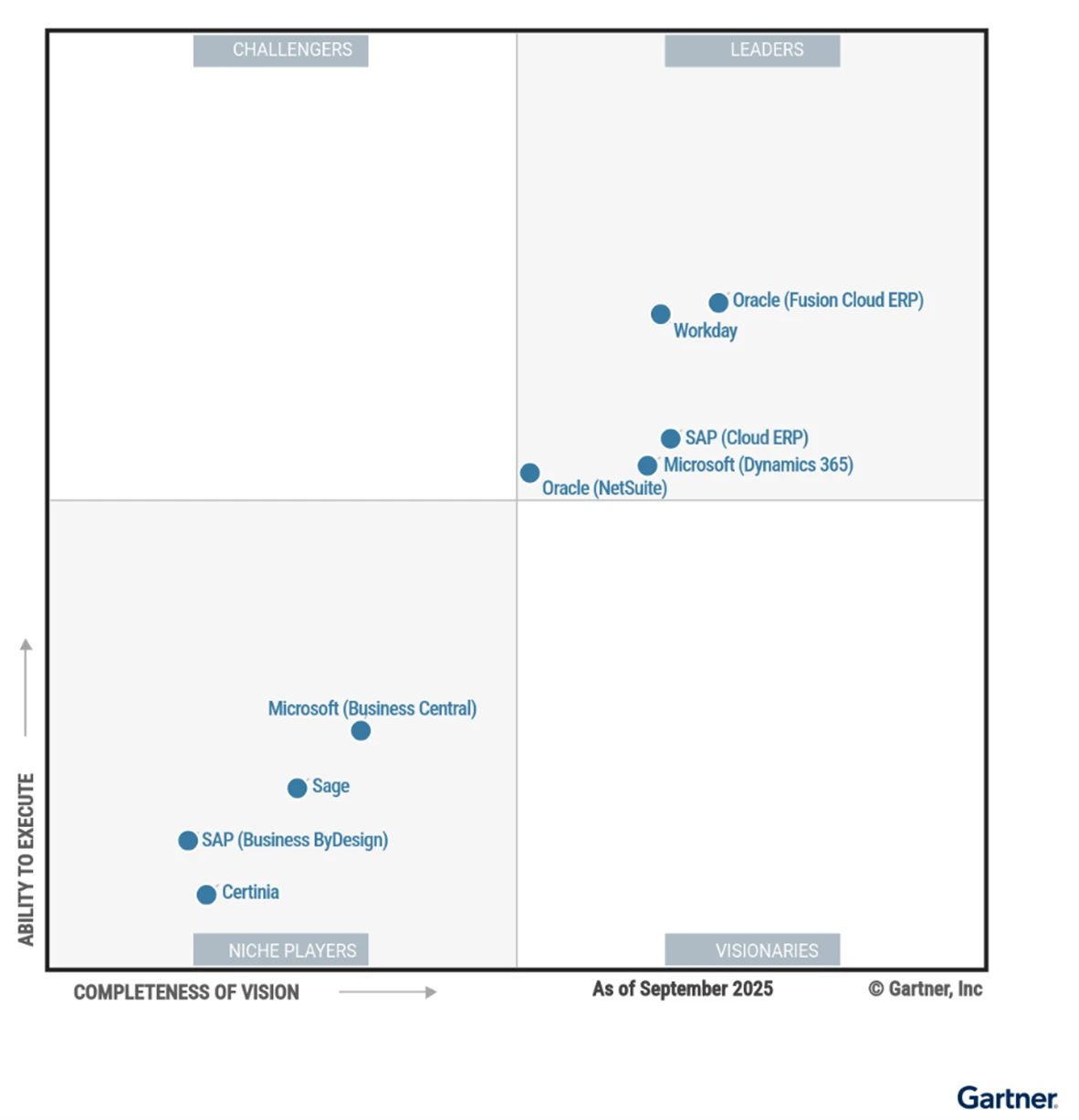
Examples include consulting firms, engineering companies, or managed service providers. Gartner noted Microsoft’s ability to support complex project based accounting and resource planning workflows in this category. This matches the needs we often hear from clients who struggle with siloed project financials or slow reporting cycles.
Product centric organisations

Manufacturers and distributors benefit from predictive planning, inventory optimisation, and real time supply chain visibility. Microsoft’s AI powered planning capabilities, supported by Copilot, help teams adjust production and procurement earlier.
Finance teams
Dynamics 365 Finance uses AI to detect anomalies, automate reconciliation, and accelerate reporting. Copilot for Finance provides variance explanations, risk flagged insights, and automated narrative summaries, all features referenced in Microsoft’s product updates.
These innovations are particularly valuable for organisations seeking faster, more reliable financial processes without increasing workload.
Strengths of the Microsoft ecosystem that reinforce this position
The wider Microsoft stack significantly amplifies the value of Dynamics 365. Gartner references this strength repeatedly.
Core advantages
- Power Platform integration enables rapid automation and app development.
- Azure’s cloud native architecture delivers global resilience and security.
- Microsoft 365 connects collaboration with operational data.
- Microsoft Fabric provides an analytics layer designed for unified data estates.
- Continuous updates remove the need for disruptive major upgrades.
For many clients, these strengths reduce long term technical debt. At ARP Ideas, we see that teams adopt change more easily when ERP is connected to tools they use daily, such as Teams, SharePoint, and Power BI.
Challenges and considerations leaders should keep in mind
A credible ERP discussion must acknowledge the complexity of modernisation programmes.
Common concerns raised by organisations
- Data migration often requires more effort than expected.
- Process redesign can slow initial timelines if stakeholders are not aligned.
- Over customisation creates long term maintenance challenges.
- Change management remains a bottleneck for adoption.
How to mitigate these risks
We recommend structured governance, early prototyping, and controlled phases. Avoiding unnecessary customisation and focusing on standard processes accelerates time to value. Training plans and internal champions remain two of the strongest predictors of success.
By preparing for these challenges, organisations give themselves a smoother path through modernisation.
What this leadership position signals for the future of cloud ERP
Microsoft’s strategic direction is clear. Its focus on composable ERP, cloud native architecture, and AI enhanced operations aligns with where the market is heading.
Dynamics 365’s roadmap places intelligence at the centre of finance, supply chain, and service operations. Copilot will play a growing role in forecasting, anomaly detection, scenario modelling, and guided decision making. These capabilities work best when built on unified, clean operational data, which is exactly what a modern ERP foundation provides.
For organisations considering a shift, this recognition signals a platform that is prepared for long term transformation, not just incremental improvements.
Key takeaways
- Gartner recognised Microsoft Dynamics 365 as a Leader in three Magic Quadrant reports, reflecting consistent performance across industries.
- Gartner praised Microsoft’s broad functional depth, strong ecosystem integration, and innovative roadmap.
- Microsoft reports measurable outcomes such as faster period close, cost reduction, and productivity improvements.
- AI driven capabilities like Copilot for Finance and predictive supply chain planning strengthen Dynamics 365’s value.
- The composable ERP design supports staged modernisation and long term flexibility.
- Organisations need strong governance, data readiness, and adoption planning to realise benefits.
Conclusion
The triple Leadership recognition reinforces Dynamics 365’s position as a modern, adaptable, intelligence ready ERP platform. It validates Microsoft’s investment in cloud native design, modularity, and AI driven innovation. For organisations planning digital transformation, this is a strong indicator of stability and future potential.
At ARP Ideas, we support organisations through assessment, implementation, integration, and adoption. If your team is exploring Dynamics 365 or preparing for ERP modernisation, we can guide you through each stage with practical experience and a structured approach.
FAQ
Is Gartner’s Leader position a guarantee of success for ERP projects?
Not a guarantee, but a reliable indicator of platform maturity and vendor capability.
What measurable improvements have Microsoft reported for Dynamics 365 users?
Examples include 30 percent faster period close, lower operational cost, and productivity increases driven by automation.
What innovations differentiate Dynamics 365 right now?
Copilot for Finance, predictive supply chain insights, AI guided processes, and a composable ERP architecture.
How does ARP Ideas support organisations adopting Dynamics 365?
We offer strategy, solution design, implementation, integration, and long term improvement support.